TCE Ege
Terminal · Aliağa, İzmir
At a glance
| Operator | TCEEGE Konteyner Terminal İşletmeleri A.Ş.[1]TCEEGE has operated within the Ege Gübre port facilities since 2009. Company name as in the site footer. |
|---|---|
| Owner | Ege Gübre Sanayii A.Ş.[2]"Subsidiary TCE EGE Konteyner Terminal İşletmeleri: container terminal operation and transport." |
| Year opened | 2009[1]"since 2009" |
| Specialization | not disclosed |
| Cargo types | Container[3]TCE Ege is a container terminal. The Ege Gübre port as a whole also handles dry/liquid bulk and general cargo (Ege Gübre, Port Services). |
| Annual capacity (containers) | 1,000,000 TEU/year[4]NoteFacility form, item 24: 1,000,000 TEU/year container (Ege Gübre port facility). TÜRKLİM's Ege Gübre card gives 1,500,000 TEU/year for the whole port (not entered as a claim because it covers the whole port, not TCE). |
| Annual capacity (cargo) | not disclosed |
| Annual capacity (vehicles) | not disclosed |
| Yard area | 289,265 m²[6]Ege Gübre port page, storage table: open concrete yard (container stacking) 289,265 m². Total port area 513,000 m². |
| Vessels served at once | not disclosed |
Berths
| Berth | Length | Depth | Use |
|---|---|---|---|
| Container quay | 705 m[5]İZKA 2021: "The dock number 1 on the west is allocated to container ships. It includes a 705-meter-long berth." Table 8 on the same page lists different rows.Sources give different values: 703 m[3] (20 November 2026); 705 m[5] (1 January 2021) | 17 m[3]"average sea depth of -17 m" (an average). Ege Gübre's guide gives 10-32 m water depth at the jetties; İZKA 2021 gives 10-27 m for the container jetty. | Container[3] |
Vessel limits
| Maximum length overall (LOA) | not disclosed |
|---|---|
| Maximum beam | not disclosed |
| Maximum draft | not disclosed |
| Maximum DWT | not disclosed |
| Largest vessel (TEU) | not disclosed |
| Vessel limit (as stated by the source) | Limited by quay length[4]NoteFacility form, item 37, berth table, largest-vessel column: "limited by quay length" for all jetties. The guide gives no numeric length, draft, DWT or TEU. Quay length is shown separately. |
Equipment
| Type | Count | Capacity | Outreach (rows) |
|---|---|---|---|
| Ship-to-shore crane (STS) | 3[4]2 Liebherr STS rail cranes, 70 t; 1 ZPMC STS rail crane, 75 t.Sources give different values: 3[7] (20 November 2026); 3[4] (10 March 2026); 2[5] (1 January 2021) | 70 t[4]Liebherr STS units; the ZPMC STS is 75 t. | not disclosed |
| Mobile harbour crane (MHC) | 2[5]MHC (Liebherr LHM500S), 2 units. | 100 t[5]Sources give different values: 80 t[7] (20 November 2026); 100 t[5] (1 January 2021) | not disclosed |
| RTG | 6[5]RTG (Kone Crane), 6 units, 6+1 high, 6 rows wide.Sources give different values: 10[7] (20 November 2026); 6[5] (1 January 2021) | 50 t[5]Sources give different values: 40 t[7] (20 November 2026); 50 t[5] (1 January 2021) | not disclosed |
| Reach stacker | 4[5]LRS (Linde), 4 units. | 45 t[5] | not disclosed |
| Empty container handler | 3[5]ECH (Terex), 3 units. | 8 t[5]Sources give different values: 9 t[7] (20 November 2026); 8 t[5] (1 January 2021) | not disclosed |
| Other | 32[7]Terminal platforms (container trailers), 65 t. According to TÜRKLİM, the Ege Gübre port as a whole has 46 terminal trailers (not entered as a claim). | 65 t[7]Row reads "65 65"; column mapping inferred from the order in the page text. | not disclosed |
Services
| Reefer connections | 440[6]"440 reefer container connections" (equipment of jetty 2, Ege Gübre page). |
|---|---|
| LCL / CFS | Yes[8]CFS services (stuffing, unstuffing, full inspection). |
| Rail connection | No[4]Facility form, item 22: no rail connection; 2 km to Biçerova marshalling station. |
| Road connection | Yes[4]Facility form, item 21: about 5 km to the İzmir–Çanakkale highway junction. |
| Bonded warehouse | Yes[4]Facility form, item 27: customs-bonded area: yes. |
| Dangerous goods | At the Ege Gübre port all dangerous goods classes except 6.2 and 7 are handled; class 1 only by direct delivery from ship.[4]Ege Gübre dangerous goods guide, section 1.2 (for the whole port facility). |
Calling services
Calling services: not disclosed.
Quiz
The answers are in this atlas's sourced data. Pick an option, then check.
Frequently asked questions
How are TCE Ege and the Ege Gübre port related?
The port facility belongs to Ege Gübre Sanayii A.Ş.; TCE Ege operates the container terminal inside it and is a 100% subsidiary of Ege Gübre. KAP's sustainability page also lists TCE Ege as the subsidiary that operates a container terminal.
What cranes does TCE Ege have?
According to Ege Gübre's 2026 guide there are 3 quay cranes (2 Liebherr, 1 ZPMC); İZKA's 2021 report lists 2 Liebherr LHM500S mobile harbour cranes, 6 RTGs, 4 reach stackers and 3 empty container handlers. The terminal's undated equipment list gives 10 RTGs. Ege Gübre's port page and the TÜRKLİM listing give 4 STS cranes for the port as a whole.
What size of ships call at TCE Ege?
According to Ege Gübre's 2026 guide the largest vessel is limited by quay length; TCE Ege's container quay is 705 m according to İZKA 2021 (the terminal's undated website: 703 m). The sources give no numeric maximum length, draft, DWT or TEU; Ege Gübre states there is no tonnage limit. In 2017 the MD3 service calling here used vessels of 6,000 to 14,000 TEU.
Does TCE Ege offer CFS and reefer services?
Yes. The terminal offers CFS services (stuffing, unstuffing, inspection) and reefer container services; Ege Gübre's port page lists 440 reefer container connections.
Does TCE Ege have a rail connection?
No. According to Ege Gübre's dangerous goods guide the port facility has no rail connection; Biçerova marshalling station is 2 km away.
Sources
- TCEEGE Konteyner Terminal İşletmeleri A.Ş.. Hakkımızda (Tanıtım). https://www.tceege.com.tr/tanitim.aspx (accessed: 20 November 2026)
- Kamuyu Aydınlatma Platformu (KAP). Ege Gübre Sanayii A.Ş. — Sürdürülebilirlik. https://kap.org.tr/en/sustainability/931-ege-gubre-sanayii-a-s (accessed: 20 November 2026)
- TCEEGE Konteyner Terminal İşletmeleri A.Ş.. Terminal Özellikleri. https://www.tceege.com.tr/terminal-ozellikleri.aspx (accessed: 20 November 2026)
- Ege Gübre Sanayii A.Ş.. Tehlikeli Yük Elleçleme Rehberi (PDF; Tesis Bilgi Formu, son revizyon 19). https://www.egegubre.com.tr/yat_dokuman/TYER.pdf (published: 10 March 2026; accessed: 20 November 2026)
- İzmir Kalkınma Ajansı (İZKA). Current Situation and Analysis on the Development of the Ports of İzmir (PDF, 2021; kapakta yalnız yıl var, 2021-01-01 olarak kodlandı). https://izka.org.tr/wp-content/uploads/pdf/analysis-portscurrentsituation.pdf (published: 1 January 2021; accessed: 20 November 2026)
- Ege Gübre Sanayii A.Ş.. Liman Hizmetleri. https://www.egegubre.com.tr/liman.html (accessed: 20 November 2026)
- TCEEGE Konteyner Terminal İşletmeleri A.Ş.. Ekipmanlarımız. https://www.tceege.com.tr/ekipmanlarimiz.aspx (accessed: 20 November 2026)
- TCEEGE Konteyner Terminal İşletmeleri A.Ş.. Hizmetlerimiz. https://www.tceege.com.tr/hizmetlerimiz.aspx (accessed: 20 November 2026)
Attributions
Values on this page come from the numbered sources above; a value without a source is not written. Data providers: TCEEGE Konteyner Terminal İşletmeleri A.Ş.; Kamuyu Aydınlatma Platformu (KAP); Ege Gübre Sanayii A.Ş.; İzmir Kalkınma Ajansı (İZKA).
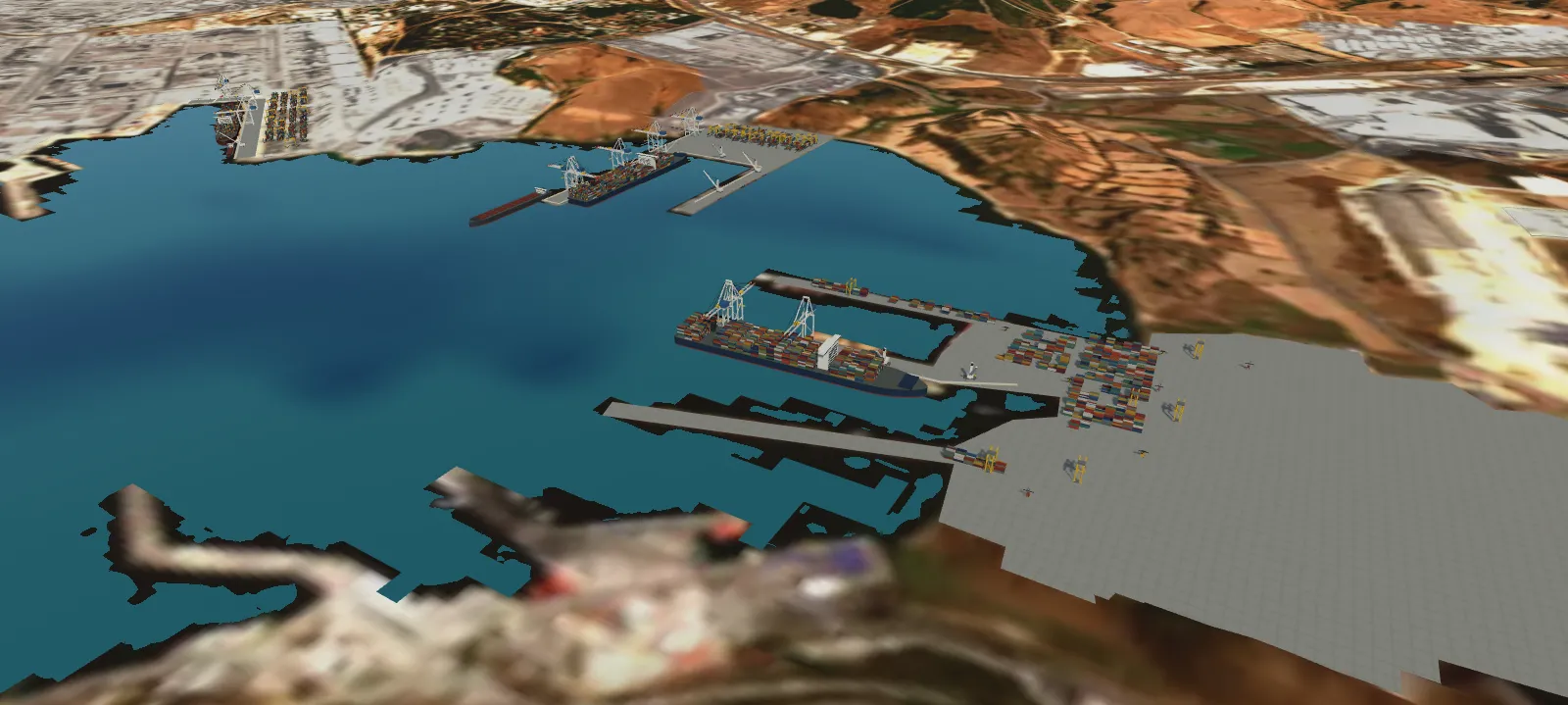
Geography and imagery in the 3D scene:
- © OpenStreetMap contributors (ODbL)
- Contains modified Copernicus Sentinel data 2026
- Copernicus DEM GLO-30 © DLR e.V. 2010-2014 and © Airbus Defence and Space GmbH 2014-2018, provided under COPERNICUS by the European Union and ESA; all rights reserved
- EMODnet Bathymetry Consortium (2022): EMODnet Digital Bathymetry (DTM). Representative colour gradient only
- Made with Natural Earth
Not for navigation. The data on this page is for information only; for navigation, berthing and port-admission decisions rely on official nautical charts and the notices of the port authority concerned.